
What should a senior fitness program in assisted living include?
A useful fitness program should support strength, balance, endurance, flexibility, and confidence with everyday movement. It should also be adaptable for residents who use walkers, wheelchairs, canes, or other mobility aids.
Fitness in assisted living is not limited to formal exercise classes. Walking to meals, standing from a chair, reaching for clothing, participating in group activities, and moving safely through hallways all contribute to physical function. The most effective programs connect exercise with the tasks residents want to continue doing independently.
In Pennsylvania assisted living settings, activity programming commonly includes movement-based options such as stretching, dancing, and other exercise. Residents should be able to ask how activities are adapted for different abilities and whether participation is voluntary.
Which types of exercise are most helpful for older adults?
A well-rounded program usually combines four types of movement:
- Aerobic activity: Walking, seated marching, light dancing, or chair-based movement can support heart and lung health.
- Strength training: Resistance bands, light hand weights, body-weight exercises, and repeated sit-to-stand movements can help maintain muscle needed for transfers, stairs, and walking.
- Balance exercises: Supported heel-to-toe walking, weight shifting, side steps, and standing exercises near a sturdy surface may help improve stability.
- Flexibility and mobility work: Gentle shoulder, ankle, hip, and back movements can make dressing, bathing, reaching, and walking more comfortable.
Residents do not need to perform every exercise at a high level to benefit. A person who cannot stand safely may still participate in seated strength, range-of-motion, or coordination activities.
For many adults age 65 and older, national activity guidance describes a weekly combination of aerobic movement, muscle strengthening, and balance activities. Those amounts are general goals, not requirements that every resident must meet. A person recovering from illness, living with arthritis, managing heart disease, or experiencing frailty may need a slower and more individualized plan.
What might a typical assisted living fitness class look like?
A typical class may last 20 to 45 minutes and begin with a gradual warm-up. The instructor might lead seated or standing movements, followed by simple strength exercises, balance practice, and a cool-down.
For example, a session could include:
- Seated marching and ankle pumps
- Arm raises using no equipment or light weights
- Repeated sit-to-stand movements from a sturdy chair
- Wall or countertop push-ups
- Side steps while holding a stable support
- Gentle stretching for the calves, shoulders, and hips
- Breathing and relaxation exercises
The class should offer more than one level of difficulty. A resident may complete an exercise seated, standing with support, or standing independently. Good instruction emphasizes controlled movement rather than speed or competition.
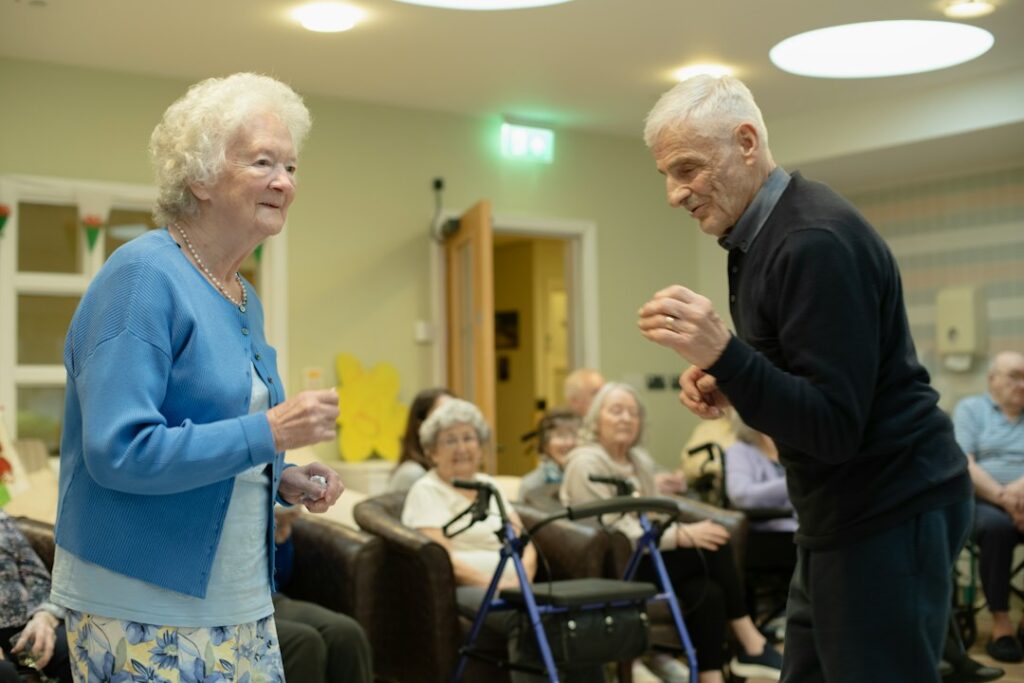
Some programs also incorporate music, seasonal themes, or familiar daily tasks. Light dancing may support endurance and coordination, while gardening-related movements can encourage reaching, squatting with support, and hand strength.
Can residents exercise if they use a walker or wheelchair?
Yes. Mobility equipment does not automatically prevent participation. Many exercises can be performed from a wheelchair or chair, including upper-body strengthening, seated marching, trunk movement, ankle exercises, and coordination activities.
Residents using walkers may participate in standing exercises with the walker positioned correctly and with adequate space around them. The equipment should not be used as a substitute for instruction or supervision if a person is unsteady.
Before beginning a new routine, residents or family members should make sure the activity leader understands relevant limitations, such as:
- A history of falls
- Recent surgery or hospitalization
- Dizziness or fainting
- Joint replacement
- Osteoporosis
- Parkinson’s disease or another neurological condition
- Chest pain or shortness of breath with activity
- Vision or hearing changes
A care plan may need to identify which exercises are appropriate, what level of assistance is required, and when an activity should be stopped.
How can seniors exercise safely during winter in Dickson City?
Cold temperatures, ice, snow, and shorter daylight hours can make outdoor walking less practical during winter. Indoor movement becomes especially useful during the colder months, when residents may spend more time inside.
Safer indoor options include hallway walks, supervised group exercise, chair-based classes, indoor walking routes, and movement breaks between activities. Floors should be dry and free of loose rugs, clutter, cords, or poorly placed furniture. Footwear should fit securely and provide traction.

Outdoor walking may still be appropriate when conditions are clear. However, icy surfaces and snow-covered walkways deserve particular caution. Residents should not feel pressured to walk outdoors simply to meet an exercise goal. Indoor activity can provide meaningful benefits when weather makes outdoor movement unsafe.
During warmer months, shaded outdoor walks or supervised gardening activities may add variety. Heat, humidity, hydration, and fatigue still need to be considered.
How often should seniors participate?
Consistency generally matters more than occasional strenuous exercise. Short periods of movement spread throughout the day may be more realistic than one long session, especially for residents with limited stamina.
A practical routine might include:
- Brief walking or seated movement most days
- Strength exercises two or more days each week, if appropriate
- Balance practice several times weekly
- Gentle stretching or range-of-motion work as tolerated
Rest days may be appropriate after illness, a change in medication, or an unusually demanding activity. A resident who becomes very fatigued after exercise may need shorter sessions, more rest, or a lower intensity.
Fitness programs should also recognize that motivation changes. Group classes can provide social connection, but some residents may prefer private hallway walks, one-to-one encouragement, or activities connected to personal interests.
What signs mean an exercise should stop?
Exercise should stop if a resident develops chest pain, severe shortness of breath, faintness, sudden weakness, unusual confusion, or sharp pain. New or worsening symptoms should be reported to the appropriate care team.
Mild muscle tiredness is different from pain that persists or worsens. Dizziness, repeated loss of balance, or unusual exhaustion may indicate that the activity is too demanding or that another health issue needs attention.
Residents should also tell staff when an exercise causes joint pain, fear of falling, or difficulty using a mobility aid. A program can often be modified by changing the position, reducing repetitions, slowing the pace, or choosing a different activity.
What questions should families ask about an assisted living fitness program?
Families and prospective residents can ask specific questions rather than relying on a general description of “activities.” Useful questions include:
- Are exercise classes offered regularly throughout the week?
- Are seated and standing versions of exercises available?
- How are residents with walkers, wheelchairs, or fall concerns included?
- Who leads the activity, and what training or supervision is provided?
- Can exercises be adjusted for arthritis, weakness, or recent illness?
- Are indoor walking options available during icy or snowy weather?
- How are changes in a resident’s ability communicated to the care team?
- Can a resident’s personal goals be included in the activity plan?
The goal is not to find the most intense program. It is to find movement opportunities that are safe, consistent, adaptable, and connected to daily independence. For many seniors, being able to stand more easily, walk to an activity, reach into a closet, or feel steadier in the bathroom represents meaningful progress.
